
Product Description
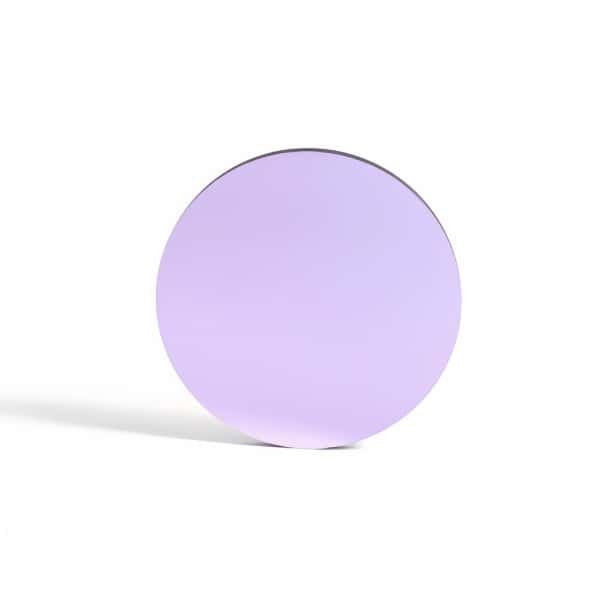
The 905 nm reflective mirror is designed for driverless LiDAR systems and controlled near-infrared optical paths. It uses a silver-dielectric tandem coating to achieve reflectivity of 99% or higher across a specified 905 ± 10 nm wavelength range, helping redirect the laser beam and preserve the returning echo signal.
The reflective surface is specified with a surface roughness of 0.3 nm and a scattering loss of 0.05%. These characteristics support efficient beam reflection and help reduce optical loss in the LiDAR signal path. The mirror can be supplied in planar, prismatic or diffuse-reflection configurations to suit different vehicle and roadside integration requirements.
According to the supplier's published data, the coating has passed 500 hours of 85 °C / 85% relative-humidity testing without wavelength shift and is intended for an operating temperature range of -40 °C to 105 °C. Final performance under the complete system's temperature, humidity, vibration and laser conditions should be validated by the customer.
The supplier also reports that the reflective design improves echo-signal strength and can be integrated with vehicle lighting, guardrails and traffic signs for road-infrastructure LiDAR applications. The quoted system-level accuracy and cost benefits should be confirmed through application-specific testing.
Key Features
- High reflectivity of 99% or higher within the 905 ± 10 nm wavelength range
- Silver-dielectric tandem reflective coating
- 0.3 nm surface roughness and 0.05% scattering loss
- 85 °C / 85% relative-humidity test duration of 500 hours
- Designed for an operating temperature range of -40 °C to 105 °C
- Planar, prismatic and diffuse-reflection configurations
- OEM and ODM customization for LiDAR and road-infrastructure projects
Product Specifications
| Attribute | Specification |
|---|---|
| Brand | UTE OPTICS |
| Product type | 905 nm reflective mirror for driverless LiDAR |
| Wavelength range | 905 ± 10 nm |
| Reflectivity | 99% or higher within the specified wavelength range |
| Coating | Silver-dielectric tandem coating |
| Surface roughness | 0.3 nm |
| Scattering loss | 0.05% |
| Operating temperature | -40 °C to 105 °C |
| Environmental validation | 500 hours at 85 °C / 85% RH; no wavelength shift reported |
| Mirror configurations | Planar, prismatic or diffuse reflection |
| Customization | OEM and ODM supported |
| Place of origin | China |
Application Notes
The planar configuration is suited to beam steering in the LiDAR optical path, while prismatic and diffuse-reflection formats can be adapted to different mounting and return-signal requirements. The mirror can be integrated into autonomous-vehicle sensing modules or reflective roadside infrastructure such as lighting fixtures, guardrails and traffic signs.
The source reports an echo-signal-strength increase by a factor of three, a ranging error below 1 cm at 180 m, and a potential system-cost reduction of 30%. These figures are application-level results from the supplier and are not a guaranteed specification for every mirror configuration. Please validate them against the complete optical system, target distance, receiver and environmental conditions.
Packaging and Delivery
| Selling unit | Piece / Pieces |
| Package type | Individual packaging |
| Minimum order | 1 piece |
| Payment type | T/T, PayPal, Western Union |
| Transportation | Air, express |
| Port | Shanghai |
Ordering Notes
Please specify the required mirror configuration, reflectance curve and wavelength tolerance, angle-of-incidence range, polarization, clear aperture, outer dimensions, thickness and mechanical drawing. Also define the substrate, surface quality, flatness, mounting orientation, environmental-test requirements and whether the 85 °C / 85% RH coating validation must be reproduced for the ordered batch.